How many days does it take to tan, why does some skin tan quickly and some never, and can you still tan with SPF 50? Here is how a tan develops, how long it takes, and what dermatologists and health authorities say about enjoying the sun without damaging your skin.
Updated on 7 November 2026 by Maria Dagiel-Petit, managing director of Belweder France.
How skin tans, and how long it takes
Tanning happens in two stages. France’s national health insurance (Assurance Maladie, ameli.fr) explains that UVA rays cause immediate pigmentation, visible within minutes but short-lived. A real tan, caused by UVB rays, is delayed: it appears 48 to 72 hours after exposure. Sunburn, on the other hand, shows up between 6 and 24 hours later, which is why it is often discovered in the evening, too late to do anything about it.
This delayed tan is a defence reaction. Afsset, which has since become Anses, describes it as adaptive pigmentation: the skin produces more melanin and its epidermis thickens, around the third day. A Tel Aviv University study, presented by Allodocteurs in 2023, clarified the order of events: cells first repair the damage to their DNA, and only then produce melanin. This is one of the reasons why some skin takes longer to tan.
In practice, it therefore takes several days of short, repeated exposures for a tan to develop, and there is no point staying in the sun longer to speed things up: prolonged exposure mainly increases the risk of burning. Sunburn is never a stage of tanning; it is a sign that the skin has been damaged.
Skin phototype: why not everyone tans the same way
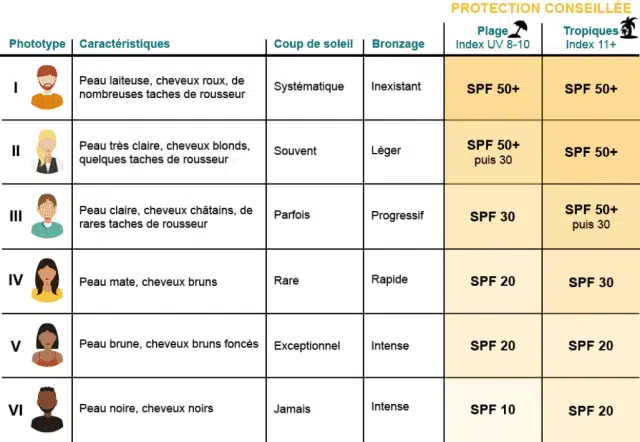
Dermatologists classify skin into phototypes, from type I, very fair, which always burns and never tans, to type VI, very dark. Dermato-Info, the website of the French Society of Dermatology, states that phototypes 2 and 3 are the most common in France: skin that reddens easily and tans gradually. Your phototype depends on the colour of your skin, eyes and hair, and on how you usually react to the sun.
Your phototype doesn’t just tell you whether you tan; it also tells you how much you are at risk. The NHS lists fair skin that burns easily among the risk factors for melanoma, the most serious type of skin cancer. Fair skin, freckles and red or blond hair therefore call for extra protection, even under a hazy sky.
Whatever your phototype, Dermato-Info advises favouring the morning or late-afternoon sun and avoiding the hottest hours, between 12:00 and 16:00. The UV index, shown by Météo-France and weather apps, is a useful guide: the NHS recommends protecting yourself from an index of 3, and Allodocteurs points out that the risk becomes high from 6. This habit applies to your lips too, which are often forgotten.
Enjoying the sun without burning in 3 steps
Choose your moment
In the morning or late afternoon, avoiding the 12:00 – 16:00 window.

Apply generously
A sunscreen suited to your phototype, reapplied every two hours and after every swim.
Protect your lips
A stick such as our SPF 20 lip balm with vitamin E, reapplied often.
The SPF 20 lip balm on video
SPF 20 sun protection lip balm
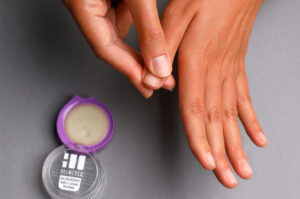
The SPF 20 lip balm in a One-Hand stick, to take with you when you’re out in the sun.
Can you tan with SPF 50?
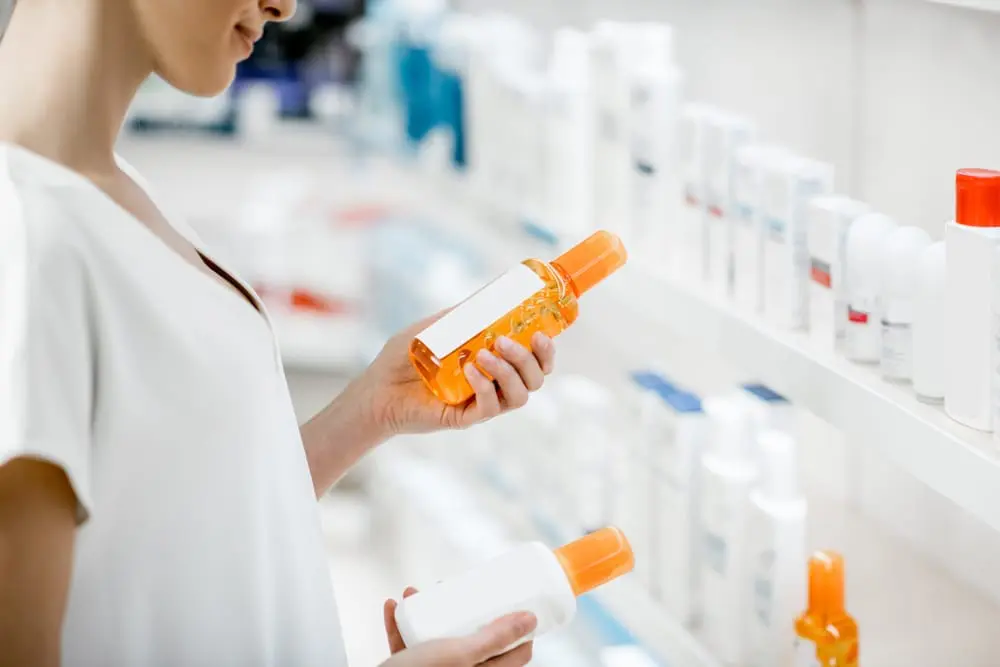
A high SPF doesn’t block everything. European Recommendation 2006/647/EC points out that no product filters out all UV rays, and for this reason prohibits claims such as ‘total sunblock’ or ‘total protection’. Products with SPF 50+ carry the label ‘very high protection’. Their SPF is measured using 2 mg of cream per square centimetre of skin, or about 36 grams to cover an adult’s body.
In real life, we apply much less. Dermato-Info explains that an SPF 30 multiplies the UV dose needed to cause sunburn by 30, but that on average people apply 0,7 to 1 mg per square centimetre, which divides the protection by two or three. Sweat, rubbing and swimming also reduce effectiveness, by up to 90% after half an hour of activity. Hence the rule: reapply every two hours and after every swim.
None of the sources we consulted claims that you don’t tan at all under SPF 50, and none promises the opposite. Assurance Maladie stresses one point above all: a high SPF does not allow you to stay in the sun longer. Météo-France adds that already tanned skin is not fully protected. To keep your tan afterwards, our article on keeping your tan after the holidays gives the right steps.
Sunbeds, capsules, self-tan: ideas that aren’t as good as they seem
Sunbeds are the worst option. Anses points out that the International Agency for Research on Cancer classified their UV rays as carcinogenic to humans in 2009, and that using them before the age of 35 increases the risk of melanoma by 59%. A sunbed tan does not thicken the skin and therefore does not prepare it for the sun. The agency is calling for an end to commercial artificial tanning, and Dermato-Info states that France’s Directorate General for Health advises against UV exposure for cosmetic purposes.
Food supplements don’t protect you either. Inserm points out that they are in no way a substitute for sunscreen, and Vidal specifies that sun protection claims have been banned on these products in the European Union since 2012.
Self-tan is the only way to tan your skin without UV, but it doesn’t protect. Dermato-Info explains that it does not involve melanin. Its active ingredient, dihydroxyacetone (DHA), colours the surface of the skin in 2 to 6 hours, and the SCCS has judged it safe up to 10% in products. Que Choisir advises doing a test on a small area and not inhaling sprays. With self-tan, sunscreen is still essential.
Frequently asked questions
A real tan appears 48 to 72 hours after exposure, according to France’s national health insurance (Assurance Maladie). It takes several days of short exposures for a tan to develop.
No product filters out all UV rays, the European Commission points out. But a high SPF does not allow you to stay in the sun longer.
Phototype I skin, which is very fair, burns without tanning. It needs maximum protection and very limited exposure.
No. According to Anses, a sunbed tan does not thicken the skin, and using sunbeds before the age of 35 increases the risk of melanoma by 59%.
Yes, lips burn too. Our guide to sun protection for lips explains the right steps.
Find out more: our guides to lips and the sun, tanned skin and free radicals and melanin, and all our lip care products. Free delivery in France on orders of €39 or more.
Sources: Assurance Maladie (ameli.fr), “Coup de soleil et conséquences sur la santé”; Afsset (now Anses), “Rayonnements ultraviolets et santé”, October 2007; Allodocteurs, “On sait enfin pourquoi certaines peaux mettent plus de temps à bronzer”, August 2023; French Society of Dermatology, Dermato-Info, “Le soleil et la peau”, 19 June 2019; NHS, “Causes of melanoma skin cancer”; NHS, “Sunscreen and sun safety”; Allodocteurs, “Bronzage, crème et coup de soleil : faut-il se protéger quel que soit l’indice UV ?”, Dr Charlotte Tourmente, August 2023; European Commission, “Recommendation 2006/647/EC on sunscreen products”, 22 September 2006; Dermato-Info, “Attention protection solaire”, 17 December 2019; Météo-France, “UV : des conseils simples pour se protéger”, 29 June 2026; Anses, “Bronzage artificiel : inutile, dangereux… mais toujours autorisé !”, 24 March 2023; Anses, “Sunbeds: ANSES issues a reminder of the proven risk of skin cancer”, 10 October 2018; Inserm, “Des compléments alimentaires pour « préparer » sa peau au bronzage, vraiment ?”, 26 July 2023; Vidal, “Les compléments alimentaires pour prévenir les coups de soleil”, updated 9 July 2026; SCCS, “Opinion on dihydroxyacetone”, December 2010; Que Choisir, “Autobronzants : nos analyses de 6 produits”, 9 May 2023.
The care products mentioned in this article
Spotted a mistake or something that needs updating? Write to us: we will check and correct the article if needed.